"Should we build in Flutter or React Native?" is one of the first technical decisions a founder makes, and one of the most expensive to get wrong. Switching frameworks six months into a build means rewriting the app, not refactoring it.
Both frameworks ship real, high-traffic apps. Neither is a wrong choice in general. The right choice depends on specifics most comparison articles skip.
Quick answer
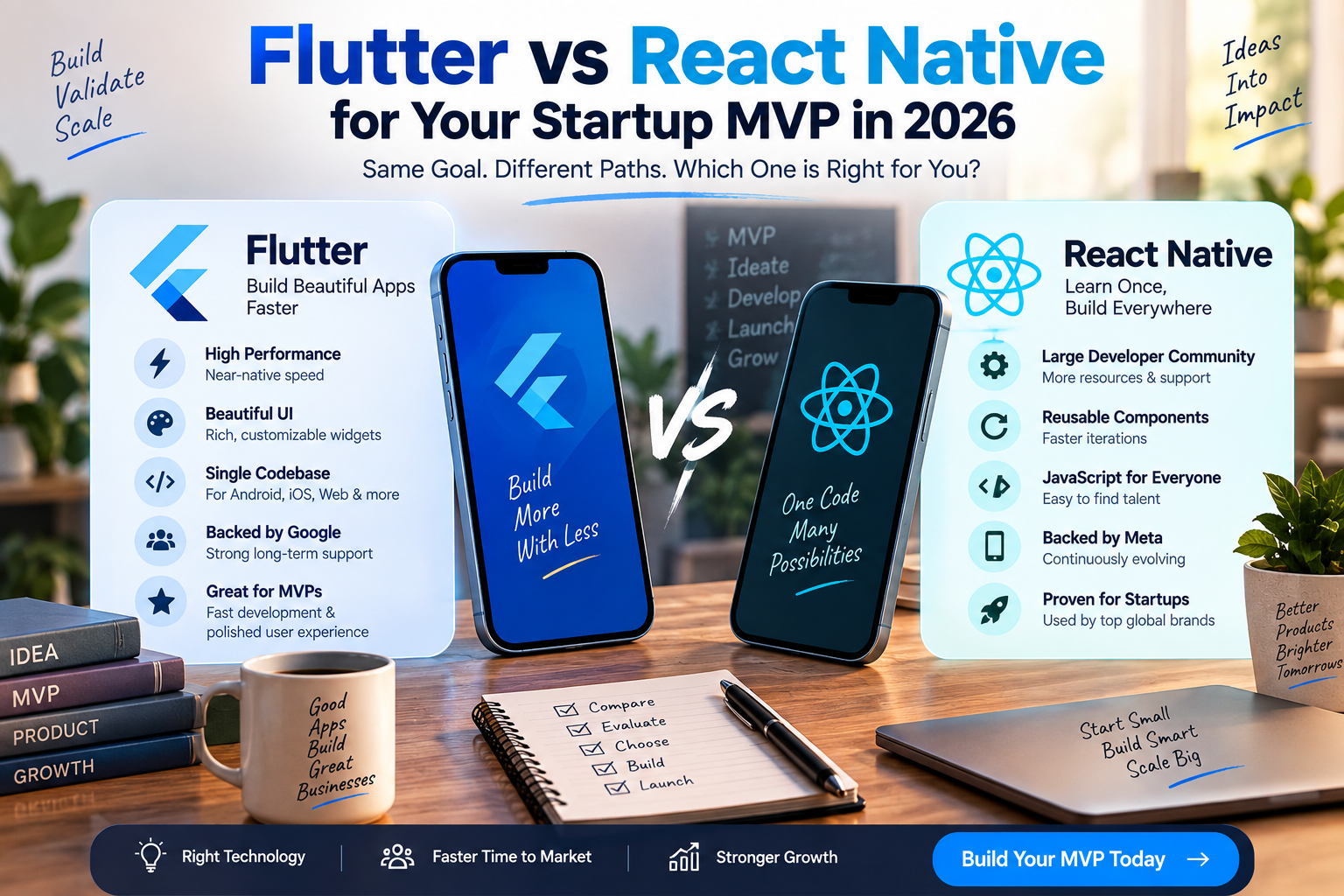
| Flutter | React Native | |
|---|---|---|
| Language | Dart | JavaScript / TypeScript |
| UI rendering | Own rendering engine (Skia/Impeller) | Native platform components via a bridge |
| Performance | Consistently near-native | Near-native for most apps, can lag on heavy animation |
| Hiring pool | Smaller, growing fast | Larger, especially if your team already knows React |
| Best for | Custom, animation-heavy, pixel-perfect UI | Apps that share logic with an existing React web app |
Neither line in this table should decide your project alone. Here's what actually matters at MVP stage.
Performance: closer than people think, but not identical
Flutter compiles to native ARM code and draws every pixel itself, which gives it very consistent performance, especially for custom animations and complex UI. React Native talks to native components through a bridge (or the newer JSI architecture in recent versions), which is fast enough for the overwhelming majority of apps but can show frame drops in animation-heavy screens if not optimized carefully.
For a typical MVP, this difference is invisible to users. It starts to matter for apps built around motion: fitness apps with custom charts, social apps with gesture-driven feeds, anything that lives or dies on how it feels to swipe.
Time to market depends on your team, not the framework
The framework that ships faster is the one your team already knows. If your engineers have shipped React or React Native before, React Native gets you to a working build faster because there's no new language to learn. If your team is starting from zero either way, Flutter's single codebase and consistent widget behavior across iOS and Android often means less platform-specific debugging.
The one exception: if you already have a React web app and want to share business logic (validation, API calls, state management) between web and mobile, React Native has a real structural advantage here that Flutter cannot match.
Ecosystem and third-party packages
React Native has a larger, older package ecosystem, simply because it's been around longer and shares roots with the web's npm ecosystem. For common integrations, payment gateways, maps, push notifications, analytics, both frameworks have solid, maintained packages.
Where this matters is for niche integrations. If you need a specific hardware SDK, a regional payment gateway, or an obscure native library, check package availability before committing to either framework. This is a 30-minute research task that prevents a costly mid-project pivot.
Native module access
Both frameworks let you write native Swift/Kotlin code when a package doesn't cover what you need. Flutter's platform channel API and React Native's native modules both work well in practice. Neither framework eliminates the need for native code entirely if your app does anything unusual with hardware, background processing, or OS-level integrations.
Cost implications for an MVP
Development cost is driven far more by feature scope and screen count than by framework choice. That said, two cost factors do differ:
- Hiring cost: React Native developers are more common in India's market right now, which can mean slightly lower hourly rates purely from supply and demand, not framework difficulty
- Long-term maintenance: Flutter's single rendering engine means less "why does this look different on Android vs iOS" debugging over time, which can reduce maintenance cost after launch
Neither difference is large enough to be the deciding factor on its own.
When we'd recommend Flutter
- You need pixel-perfect, custom UI that should look identical on iOS and Android
- Your app has animation-heavy or gesture-heavy screens
- You're starting fresh with no existing React codebase to share logic with
- You want one codebase with the fewest platform-specific surprises
When we'd recommend React Native
- You already have a React or Next.js web app and want to share logic
- Your team already has strong React experience
- Your app relies heavily on a specific native library that has stronger React Native support
- You want access to the largest possible hiring pool for post-launch maintenance
What we use at Plazmasoft
We build in both, and we pick based on the criteria above rather than a house preference. For founders who don't have a strong opinion either way, we default to Flutter for new mobile MVPs, mainly because of the consistent cross-platform rendering and lower long-term maintenance overhead, and we default to React Native when there's an existing React web app to share code with.
If you're not sure which fits your project, that's exactly what a discovery call is for. We'll look at your specific requirements, not just recommend whichever framework we personally prefer.
Frequently asked questions
Can I switch from React Native to Flutter later, or vice versa? Not without a near-complete rewrite of the UI layer. Business logic on the backend is unaffected, but the mobile app itself would need to be rebuilt. This is why the choice matters more at MVP stage than people expect.
Is Flutter or React Native better for App Store approval? Neither has an advantage here. Both produce standard native app bundles, and approval depends on your app's content and behavior, not the framework used to build it.
Do I need separate iOS and Android developers if I use Flutter or React Native? No, that's the core benefit of both frameworks: one codebase, one team, both platforms. You only need platform-specific expertise for native modules or deep OS-level integrations.
Which framework is better for a two-sided marketplace app? Either works well. The bigger technical decision for a marketplace is usually the backend architecture and real-time features, not the mobile framework.